
Every Stitch Matters: Inside the Hand-Guided Process at Heirloom Stitching
In Nottawa Township, where open farmland and small businesses shape the landscape east of Three Rivers, a quiet manufacturing operation is turning out hundreds of boot uppers a day through a process that depends as much on skilled hands as it does on machinery.
Heirloom Stitching, an Amish-run facility led by owner Sam Bontrager, produces boot uppers for partner brands including Thorogood and Sloggers. At full pace, the operation can produce up to 600 pairs of Thorogood boots a day and up to 750 pairs of Sloggers a day. What moves through the building, though, is not a finished boot. The stitching work is done here, then the product moves on so partner companies can add the sole and complete final construction.
From the outside, it would be easy to underestimate what is happening inside.
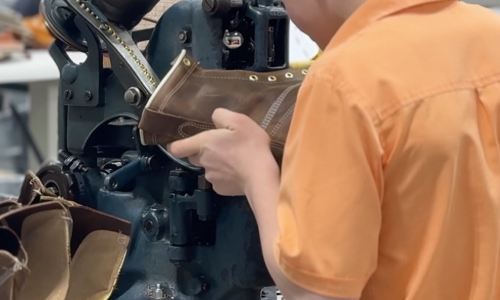
A finished boot upper may look straightforward, but the work behind it is anything but simple. Bontrager says it takes 132 steps to complete one pair of boots, with skilled hands guiding every step. Operators feed pieces through the machines by hand, controlling alignment, tension, consistency, and the visible stitch lines that define both the appearance and structure of the finished product.
That level of detail is also what raises the stakes.
At Heirloom Stitching, many of the seams remain exposed, which means mistakes are not hidden inside the finished product. If a stitch is off, it cannot simply be covered up or corrected later. The entire boot has to be scrapped. In a process built around visible precision, quality is not something checked only at the end. It has to be maintained from station to station, piece to piece, throughout the line.
That pressure is part of why the learning curve is so real.
According to Bontrager, a new employee typically needs about a year before they are truly good at the job. It can take closer to a year and a half before the work starts to feel easier. That timeline says a lot about the kind of operation Heirloom Stitching is. This is not fast casual assembly work where someone can step in and master the line in a few weeks. It is skilled production that depends on repetition, patience, and judgment developed over time.
The shop currently employs 19 full-time workers, with room to comfortably grow to around 25. The workday starts early, with shifts running from 5 a.m. to 2 p.m., setting a steady rhythm for an operation built around consistency. Across the floor, machines help move production forward, but the process remains deeply hand-guided. Workers are not simply pressing buttons and watching parts move by. They are actively shaping the outcome at nearly every stage.
That combination of craftsmanship and output is part of what makes the operation notable.
In many manufacturing settings, scale and handwork can feel like opposites. At Heirloom Stitching, they exist side by side. The shop is producing at volume, yet the work still depends on people who know how to guide material cleanly, keep lines consistent, and catch flaws before they move farther down the process. The result is a type of manufacturing that feels both traditional and highly disciplined.
Its location is part of the story too.
Bontrager said Nottawa Township made sense because of family ties and the opportunity to purchase the property there. He also spoke with a clear sense of pride about the community, describing it as the kind of place where people know what they have. That local connection comes through in the operation itself. Heirloom Stitching is not positioned as a flashy brand-forward facility. It is grounded, practical, and focused on doing one thing well in a place that fits the work and the people behind it.
That kind of story can be easy to miss from the outside. A boot on a store shelf rarely tells the full story of how many hands, decisions, and repeated motions shaped it before it ever reached the final stage. At Heirloom Stitching, that unseen part of the process is the entire point. Long before the sole is attached and the boot is boxed, the standard is already being set in the upper, one seam at a time.
For Southwest Michigan, it is another reminder that some of the region’s most impressive work is happening in places many people will never think to look. Not every story of manufacturing starts with a ribbon cutting or ends with a recognizable public face. Sometimes it starts before sunrise in a warehouse in Nottawa Township, where the smallest details carry the biggest weight.